
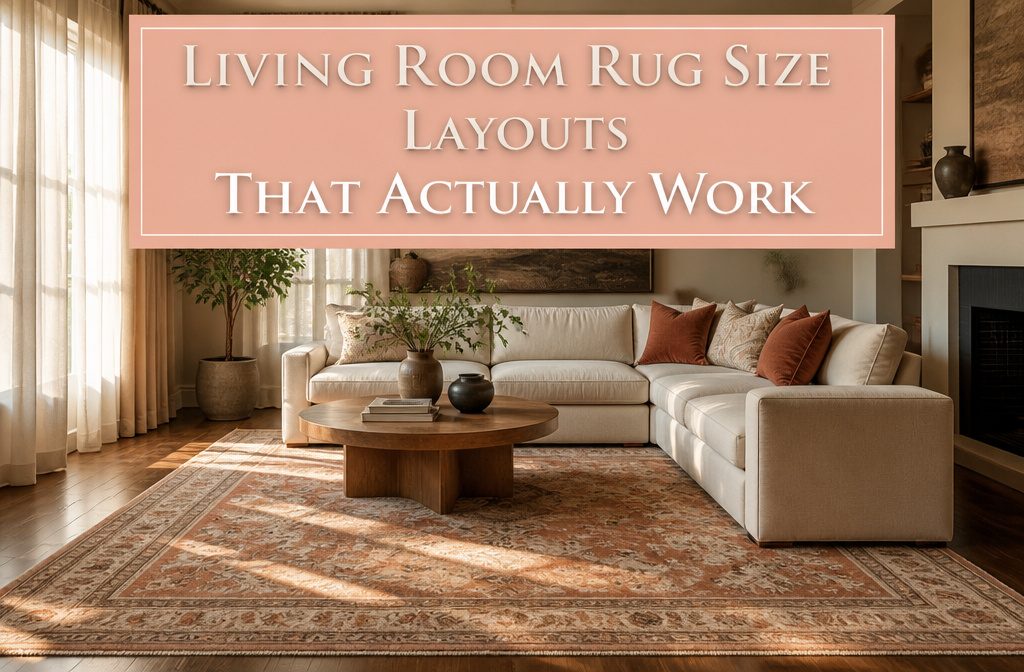
A living room rug size guide shows you which rug dimensions anchor your seating arrangement without crowding the baseboards or leaving furniture stranded on bare floor.
The layout that trips up most rooms is the too-small rug: when an 8′ x 10′ sits only under the coffee table and the sofa floats behind it, the whole grouping reads as disconnected rather than intentional.
1. All Legs On the Rug
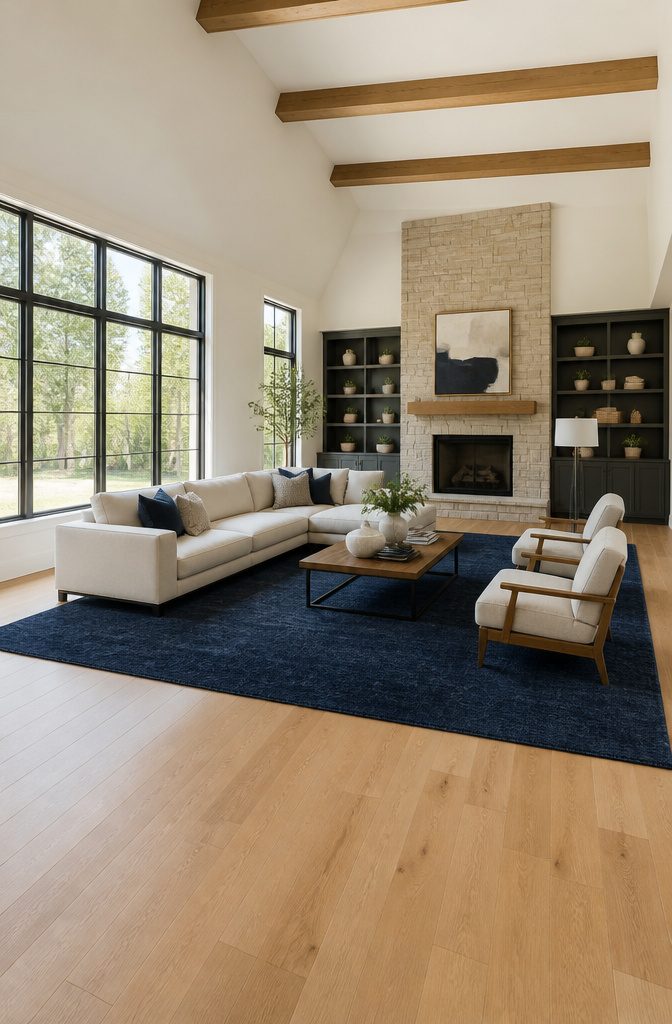
All furniture legs on the rug creates the most unified look, but you need a large room and a larger rug to pull it off.
I recommend a 9′ x 12′, 10′ x 14′, or bigger depending on your furniture footprint.
This layout works best in open-concept floor plans or formal seating groups where the sofa, chairs, and coffee table all sit completely on top of the rug.
The effect is dramatic. The rug reads as the floor of the room rather than an accent on top of it, which is especially effective when your furniture floats away from the walls.
The rug becomes the architecture of the seating area, creating a room within a room without needing walls to divide the space.
Leave at least 12 to 18 inches of exposed floor between the edge of the rug and the walls to maintain proper proportion. Without that border, the rug looks like wall-to-wall carpeting that came up short.
2. Front Legs On
Front Legs On
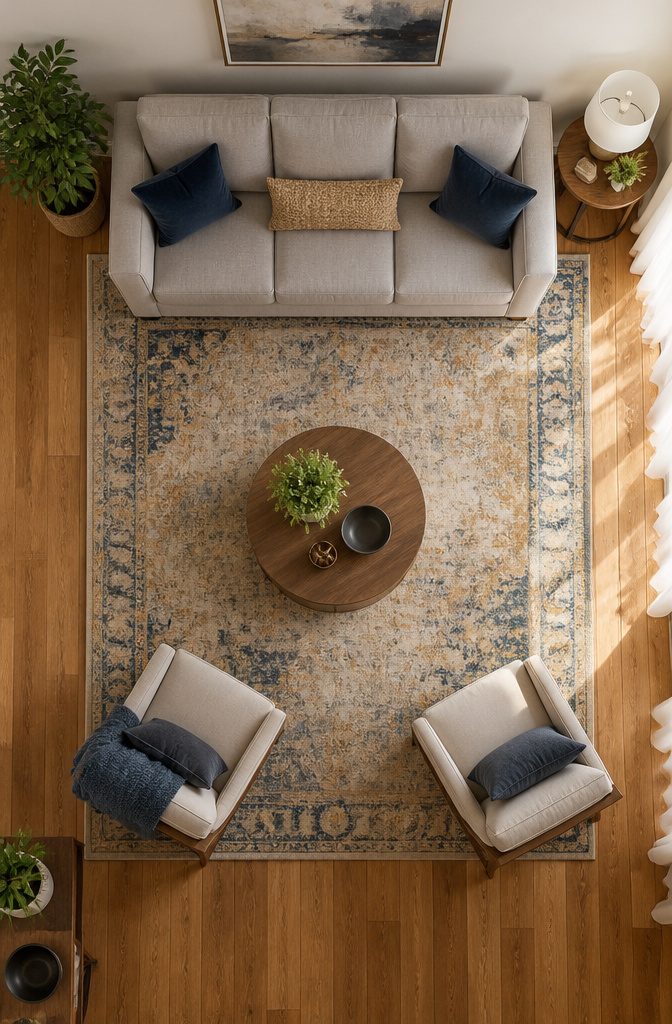
The front-legs-on layout is the most flexible option you have. The front legs of the sofa and chairs rest on the rug, while the back legs sit on the floor.
This gives you the grounded look of a unified seating area without needing a rug large enough to swallow the entire room.
For this layout, an 8′ x 10′ rug works in medium living rooms (roughly 11′ x 13′ to 12′ x 15′), and a 9′ x 12′ handles larger spaces or rooms where you want more breathing room around the furniture.
The rug should extend 6 to 8 inches beyond each side of the sofa so the proportions feel balanced rather than cramped.
I reach for this layout more than any other because it suits both traditional and contemporary rooms equally well, and it works whether your seating faces inward or lines up against a wall.
When you’re torn between two sizes, the larger one is almost always the safer choice.
3. Coffee Table Only
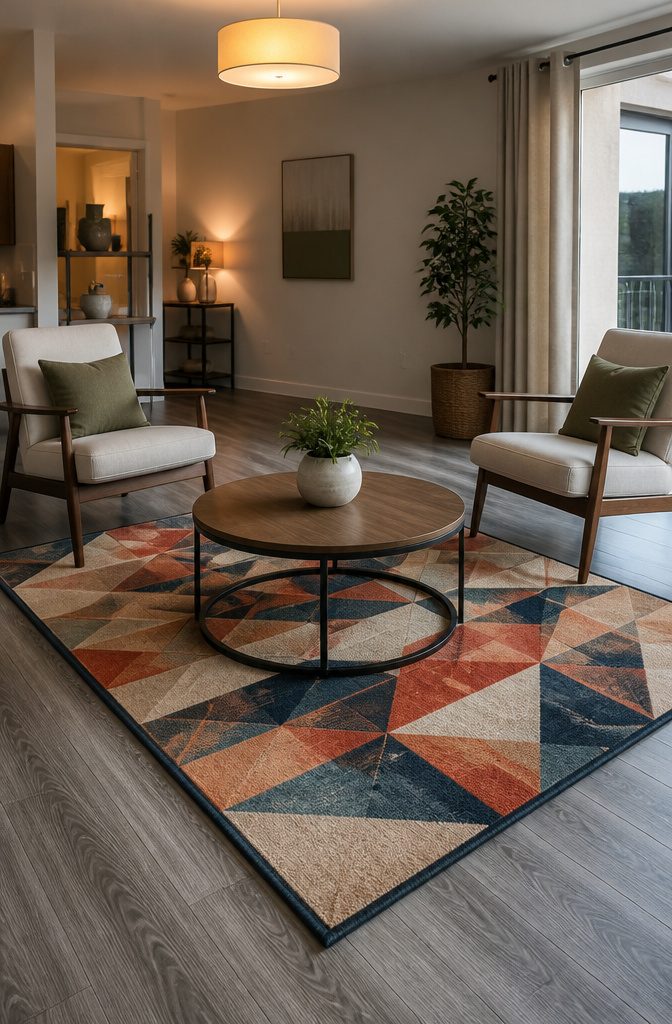
The smallest layout puts the rug under the coffee table alone, with all your seating arranged around it on bare floor.
For small living rooms or tight apartment footprints, a 5′ x 8′ or 6′ x 9′ rug defines the coffee table zone without crowding the floor.
This setup works when you need to keep walkways open or when a larger rug would push furniture too close to the walls.
The risk is that the rug reads as a floating island if it’s too small relative to the sofa length.
The rug should run past each end of the sofa, even if the sofa itself sits off the rug. A 3′ x 5′ accent rug under a full-size coffee table makes the room feel smaller than it is.
If you go this route, keep the gap between the furniture edge and the rug edge to five inches or less so the whole arrangement still feels grounded rather than disconnected.
4. Leave 12 to 24 Inches of Bare Floor
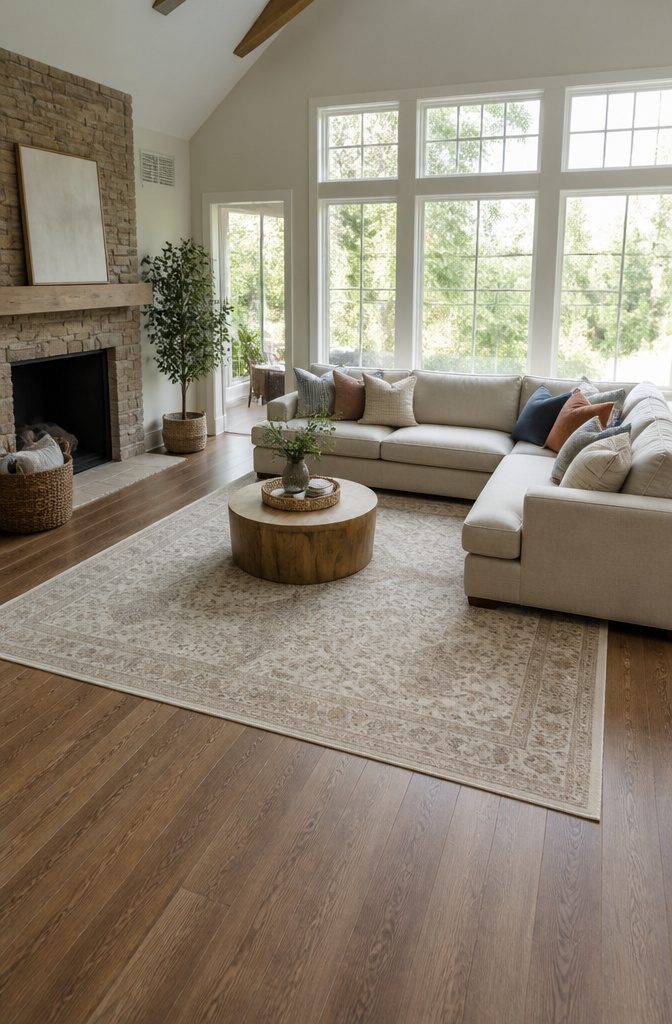
The rug should stop 12 to 24 inches from the walls in most living rooms. That band of exposed floor keeps the rug from crowding the baseboards and gives the room breathing room.
In smaller or standard-sized rooms, aim for 12 to 18 inches. In large open-concept spaces, you can stretch that to 24 inches and still maintain proper proportion.
I check this measurement first because it solves two problems at once. The margin frames the rug as a zone rather than wall-to-wall carpeting, and it makes sure doors swing open without catching on the pile.
A rug that runs too close to the threshold will fold under the door every time someone opens it, and that wears the edge fast.
How the Rug Anchors Your Seating
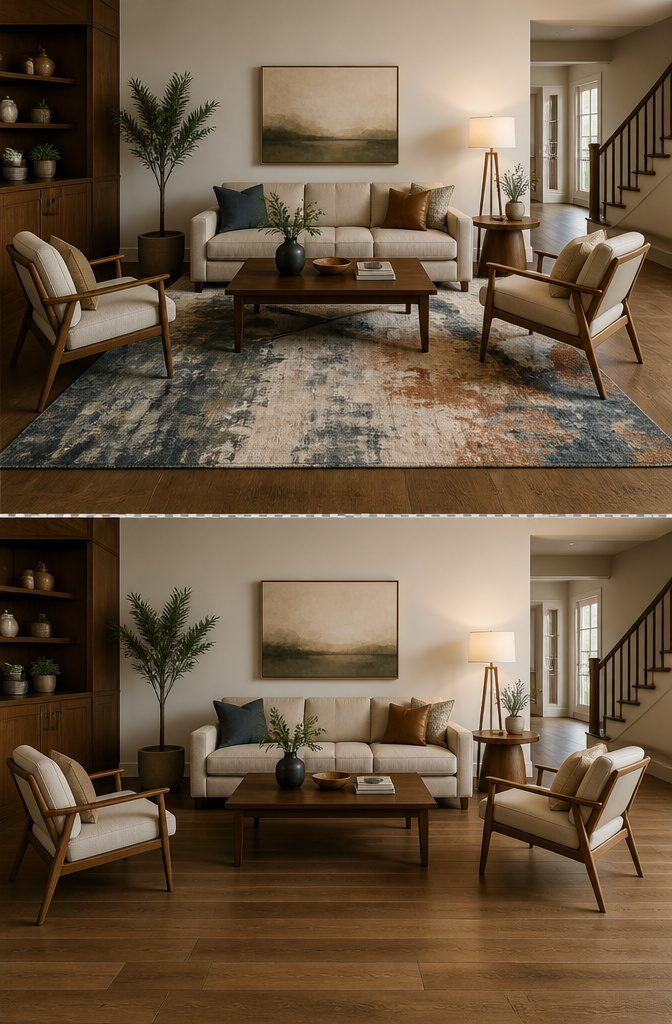
At least the front legs of all seating should land on the rug.
That means the front feet of the sofa and every chair in the grouping sit six to eight inches onto the rug, while the back legs rest on the floor.
This pulls the furniture together into a single conversation area instead of leaving the rug stranded in the middle like a floating mat.
I anchor the rug to the seating group, not to the center of the room. When furniture floats away from the walls, the rug defines the architecture of the seating area and creates a room within a room.
If the grouping sits against a wall, the same rule applies: front legs on, rug extending at least six to eight inches past each side of the sofa for balance.
The Too-Small Rug Mistake
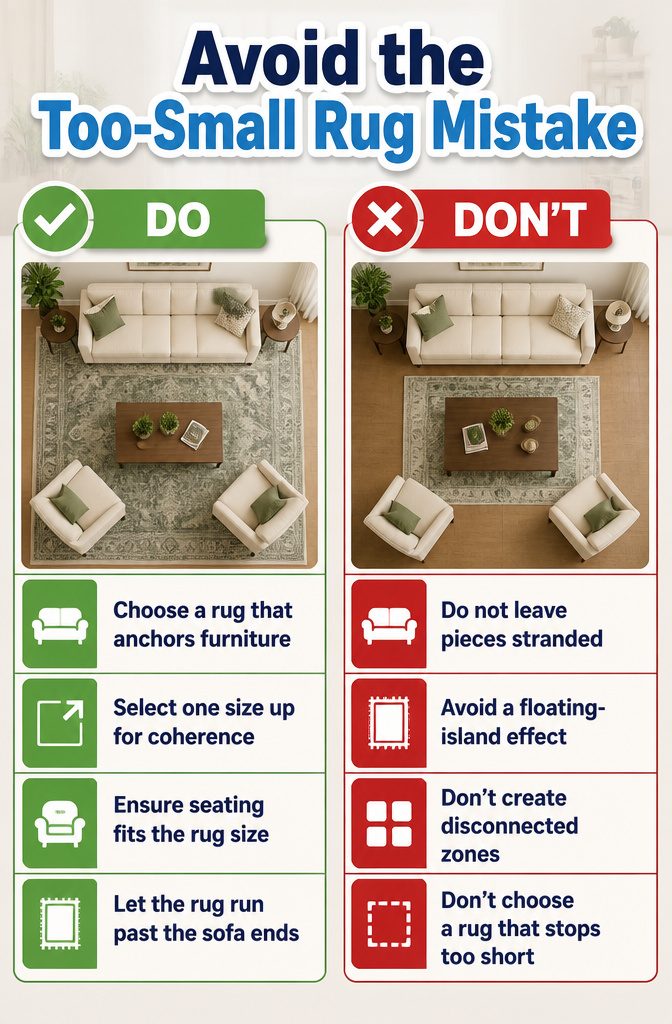
The single mistake I see more than any other is a rug that stops short of the furniture it’s supposed to anchor.
When a rug sits only under the coffee table and leaves the sofa and chairs stranded on bare floor, the whole arrangement reads as disconnected rather than intentional.
The pieces look like they wandered in separately instead of belonging to a shared conversation area.
If a rug is too small, it may appear lost and the space can feel disjointed.
That floating-island effect is what happens when a rug doesn’t give the seating a shared foundation. Even good furniture starts to feel scattered.
The fix is almost always one size up: an 8×10 becomes a 9×12, or a 9×12 becomes a 10×14. The room pulls together the moment the rug runs past the ends of the sofa and gives the chairs somewhere to land.
Use Painter’s Tape to See the Size
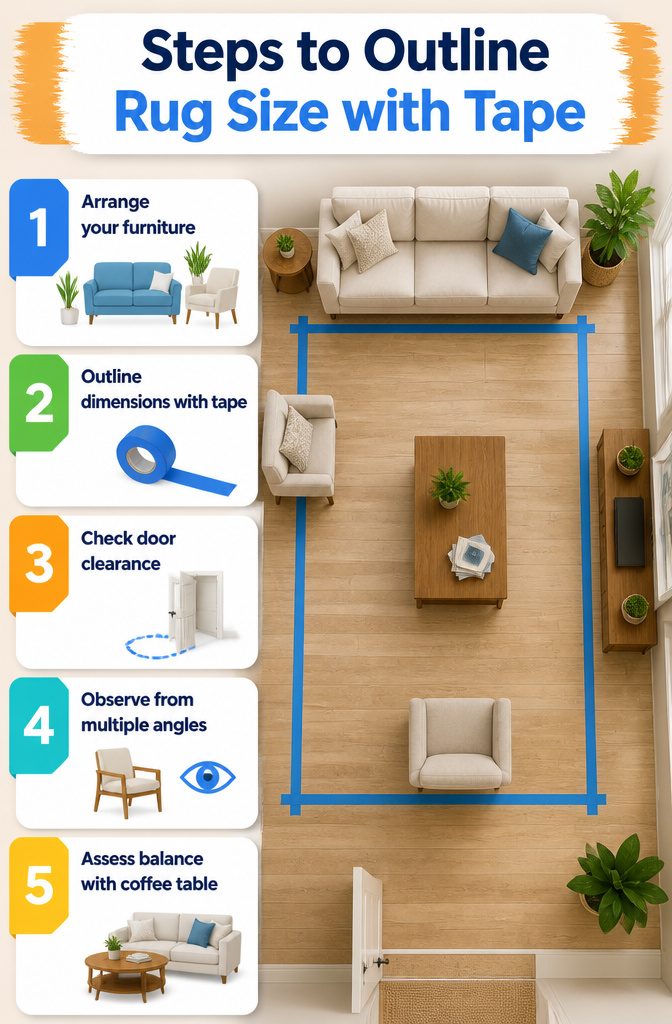
Before you buy anything, outline the rug’s footprint on your floor with painter’s tape.
Arrange your furniture where you want it, then tape down the exact dimensions you’re considering. The blue kind peels up cleanly and won’t leave residue on hardwood or tile.
Walk the room once the tape is down. Check that doors can swing open without catching the edge, and that the path from the entry to the sofa stays clear.
Step back from a few angles and see whether the taped rectangle looks balanced under your coffee table or whether it reads too small.
I’ve talked myself out of undersized rugs more than once just by seeing the outline against the furniture that’s already there.
If the proportions feel off at this stage, they’ll feel worse once the rug arrives and you can’t return it.
Frequently Asked Questions
What size rug should I use in my living room?
An 8′ x 10′ rug works in medium living rooms (roughly 11′ x 13′ to 12′ x 15′), while a 9′ x 12′ handles larger spaces.
The rug should extend at least 6 to 8 inches beyond each side of your sofa so the proportions feel balanced. When you’re torn between two sizes, go larger.
How far should a rug be from the wall?
Leave 12 to 24 inches of bare floor between the rug and the walls. In smaller or standard-sized rooms, aim for 12 to 18 inches; in large open-concept spaces, you can stretch that to 24 inches.
This margin frames the rug as a zone rather than wall-to-wall carpeting and makes sure doors swing open without catching on the pile.
Should a sofa sit fully on a rug?
It can, but it doesn’t have to. The front-legs-on layout is the most flexible option: the front legs of the sofa and chairs rest on the rug, while the back legs sit on the floor.
This gives you a grounded seating area without needing a rug large enough to hold all the furniture.






